For expats moving to Vietnam, getting around is always a worrying issue. For us peasants who don't have a company car and who can't afford a private car, there's little other option. But it's not all bad.
It must be understood that transport in Vietnam still relies heavily on two wheels. Public transport is poor and unsafe and only the wealthy can afford cars. If the family wants to take a trip then the motorbike is by far the most convenient and cost-effective means, and for the vast majority, the only choice. Yes, it can be seen as dangerous, but Vietnam is still a poor country where the standard of living is below that of what we might be used to in 'the west' (or what we were used to, see Greece, UK in a few years).
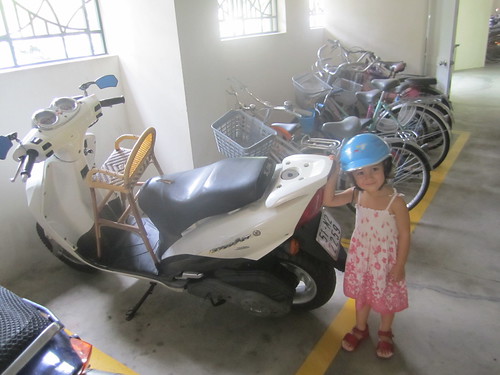
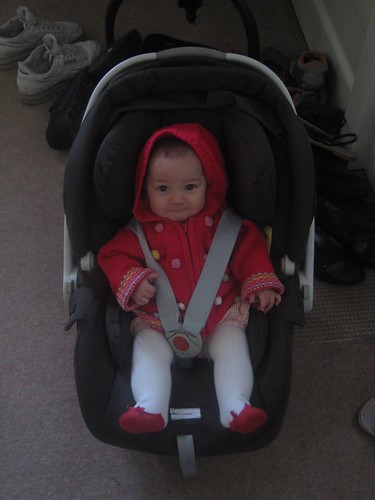
Upon arrival in South East Asia the sight of children, toddlers and even new born babies on a motorbike is shocking. I'd agree, it's not great, particularly in Saigon's inner center, not least because of the traffic but also the horrible fumes which can't be great for young lungs. But it needs to be understood that most Vietnamese parents are not being reckless and take as many safety measures as possible when travelling with their children. There are those cases you see where there is recklessness, allowing toddlers to stand up on the seat, riding without a helmet, driving too fast - but these are the minority.
There is also the context of the journey to consider. I take my daughter on the motorbike, but only out in Phu My Hung, very rarely on longer journeys. If we need to travel into the city or beyond we'll take a taxi - thankfully, we can afford that. Also, whenever driving with Louisa, I drive with extra caution. Some might say that doesn't make a difference, but I feel it certainly cuts the odds a great deal. I also feel in complete control whilst driving with her around my local streets - I would never take her on Highway 1A with articulated lorries thundering past.
So for those with children considering transport issues I would ask firstly do you have an alternative (car with driver, taking taxis everywhere) and secondly do you feel comfortable driving with your child on your motorbike?
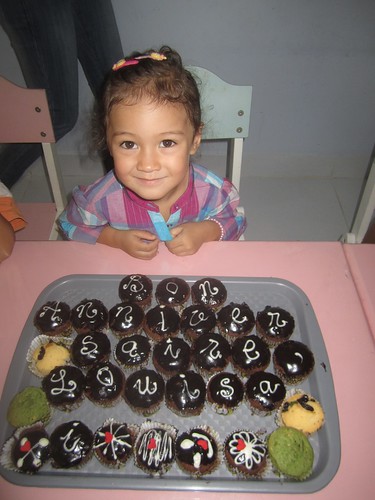
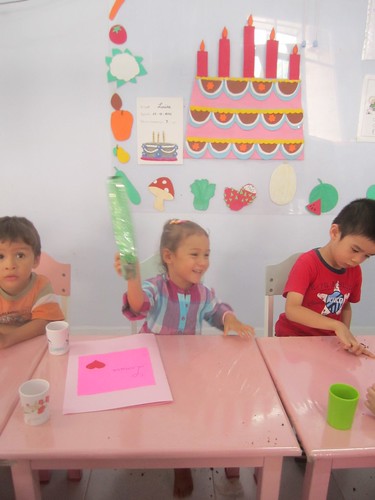
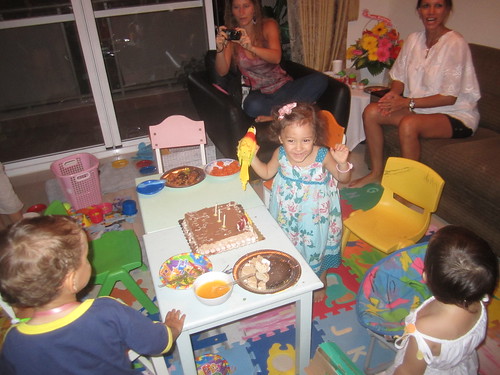
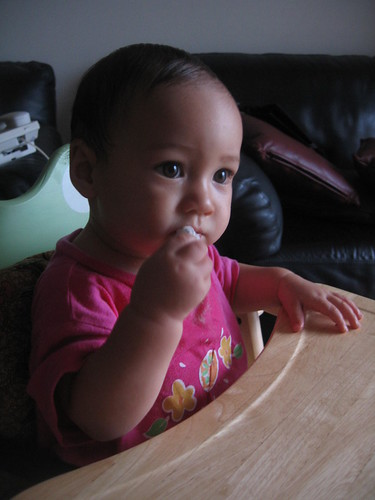
Don't they grow up quick! It seems crazy but my little baby girl is a three year old now. She grows more fabulous and loving every day I see her, with her mad curly hair, inquisitive eyes and her insatiable sense of adventure and fun. Growing maturity is something so thrilling to see before your own eyes - all that hard work is paying off. Louisa had a party at her nursery and some friends over in the evening, with mums and dads too.
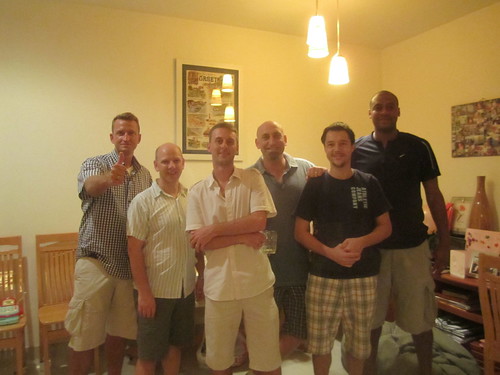
The dads at the party
I realised what a select group of dads there were here at the party - on the far left a German Vietnam Airlines pilot, on the far right a Brazilian professional football player in the V league, right of me a friend who is finishing his Phd in Vietnamese History, left of me a guy who works in Kazakhstan in the oil industry a month on and a month off, and second right of me an old friend from Catalonia who works in Hotel/Property management. And then there's me, an I.T teacher. You don't need to tell me, I already know.
My daughter will be two and half in June and as with the many mixed couples in Saigon, she is growing up bilingual. In actual fact, she is growing up TRILINGUAL. I find the understanding of this issue to be a total paradox. On the one hand, we are constantly asked 'Can she speak English?' and are met with wide eyes of astonishment when the answer is yes or when she turns to me and starts speaking English. We also send Lousia to a nursery nearby where only French is spoken. She can already count and sing songs in French too, but not at home because she knows mum and dad don't really understand her toddlers version of French. I am already feeling horribly inadequate and have a couple of French courses downloaded ready to brush up! You may be asking why do that? Indeed some parents I have met are too concerned that their child would be 'confused' by a third language. I am utterly convinced that is not the case.
Scientists believe that language is acquired most easily during the first ten years of life. During these years, the circuits in children’s brains become wired for how their own language sounds. An infant’s repeated exposure to words clearly helps her brain build the neural connections that will enable her to learn more words later on. Language can be learned a multitude of ways, like casual conversation, songs, rhymes, reading, music, story telling and much more.[from here]
I have known kids as young as five who can speak four or even five languages. Example: a French friend married a Thai lady and had three kids who went to a British school and learned Mandarin. We don't intend to push our daughter into learning French as if it was a classroom subject. Rather just give her the exposure and see how she picks it up. Some of you may remember too that Chi's little brother has lived in France since he was one and is now eighteen. He doesn't speak Vietnamese, only French and school taught English. We see France as a distinct possibility in our future, so that's our added motivation, not that you need one either way..
The other half of the paradox is that for a huge portion of the worlds population, growing up BI or TRILINGUAL is normal. Think of all the people in the subcontinent, Singapore, Malaysia, The Phillippines, Africa and so on who grow up speaking more than one language. Think of it like that and we are just catching up with the rest of the world...and I know for sure that Louisa's peers, in this 'international' environment, will also be multi-language speakers.
Those of us bethrothed to a lady of another nationality have not only the Mars/Venus collision to deal with but also the at times stupendous cultural differences to hurdle and manage. Understanding women is the holy grail of any man's life. Cultural 'clashes' however are certianly not always down to the wife and the wife alone, the accompanying family can have a large part to play in our headaches ( I will use the possessive pronoun 'our' representing all my bretheren in this situation).
In my experience potentially the most explosive sitauations are tiny misunderstandings. Things so easily get lost in translation, a sea of idioms, facial expressions and lost sarcasm. Never communicate important matters in writing. In the larger, longer term picture - we have to accept that there are some things about the Vietnamese that a foreigner may never understand - and that's not a bad thing either. For some it adds to the mystery and excitement. To others, it mounts into a burden of frustration. I know of many who have split from their foriegn spouses - but statistically we know of the divorce rates in western countries and should image the rate of divorce in mixed marriages is no higher if not much less. This article talks about it a little.
Now add children.
Our little babies come into the world and bless em they take over our lives and we watch them grow with joy. Parenting is a contentious issue in any household, never mind one that has to share the mindset of two continents. It starts from birth. Vietnamese traditions with regards to the birth of a child are not for the fainthearted and include the mother moving back in with her family, not leaving the house for a month and also not showering. Amongst many, many others. Personally, I think it all a load of nonsense with no basis in reality, but that's an opinion. I would have struggled to go along with it all if I was in a traditional family. Chi is also not worried or concerned with 'traditions' of this nature and although she has a large family, they are not close. Furthermore we had Louisa in England, away from all that cultural interference that, I am sure, just adds to the stress of the new mother who just wants to be left alone with her new baby. For this, Chi was doubly glad. It was a nice start. Others suffer the brutal onslaught of aunts and nannies and grandmothers storming the poor little thing and dicatating the environment and conditions of the first weeks and months. I guess it all depends on your family situation, but I'd imagine most westerners come to a compromise with thier adopted families - as in, when to back the expletive away from my little son/daughter and let me do it.
As soon as we returned to Nam with our 7 month old daughter under our arm the 'advice' began. Two tendancies the Vietnamese seem to have towards babies. One is to gorge them on food - gigantic bottles of formula milk being shoved into their mouths. When they should be moving onto solid foods (natures hint is the teeth she provides), they tend to be force fed bottles of liquid food as well, even until they are 2 or older. Louisa has been chewing on carrots and eating rice since she was younger then a year old. Concerned aunts seemingly try and grind Chi down by saying that Louisa is 'too thin' just because she is not as 'plump' as all the other babies. You can see them with a big bottle of food and a small towel hidden behind their backs just desperate to shove the whole lot down her throat and fatten her up. Well, she looks OK to me. Proud to say, 100% breast fed till this very day.
Taking a walk in the park and a Vietnamese father in broken English asks me when Lou started to run around like a maniac, as she was at the time. I told him she started walking between nine and ten months old. Rather pitifully he looked at his 13 month year old son who still could only sit on his bum. 'What kind of milk does she drink'? he asked me, as if all he needed to do was change his brand and suddenly his son would be up and about. Sure, children develop at different speeds, but absolutely no doubt about it, the environment you create for them has a massive impact as well. And this is point number two. We call it mollycoddling. Overprotection. Incessant carrying of the child doesn't help it develop muscles in order to lift its head, then crawl, then grab the furniture and haul itself up and eventually take its first steps. Babies get carried here I feel way too much when they should be left on their backs and then their fronts in a safe space on the floor. It is also, in my opinion, essential that baby smacks his or her head on the table in order to learn that table is hard and it hurts when you smack your head on it. Same goes for eating dirt/flowers/grass/grit/fluff etc. Depriving these sensory learning experiences that wire the brain with a proper understanding of the world impedes development.
I would add my own disclaimer - T.V. This flickering, confusing and noisy instrument has no educational benefit for young children - yes, even if it is on Disney channel. What it does do is interfere with the development of the area of the brain that handles attention - and the ability to hold attention. Whilst the child is staring hypnotised at the machine it is missing out on the more important happenings around it such as watching and hearing the conversations of adults in the room - amongst the many health problems associated with over exposure to TV is attentional disorders and speech problems. Anyone wants a copy of this book, mail me. I digress, TV is by no means an exclusively Vietnamese problem.
Hopefully I've explained some of the pitfalls and tribulations involved in a mixed marriage and raising children within one, and some of the irritations I have come across being a father in Vietnam. All stereotypes within this post must be forgiven for the sake of the whole.
Finally, here's our daughter Louisa, 16 months old, with her latest trick, making herself dizzy when the music comes on...
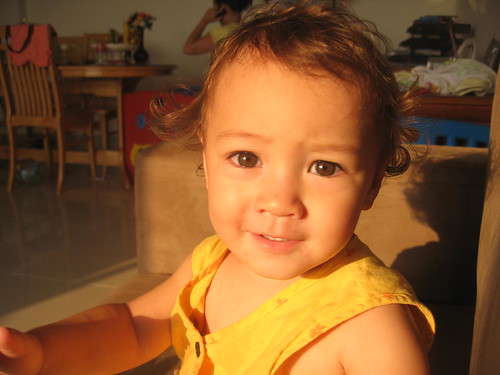
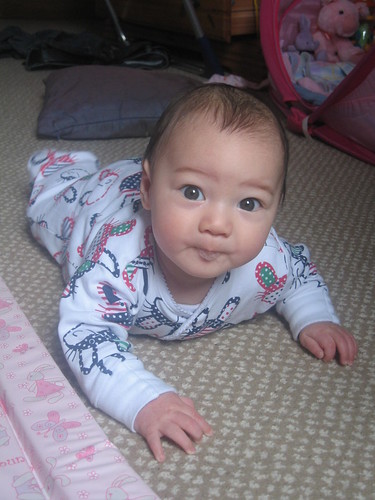
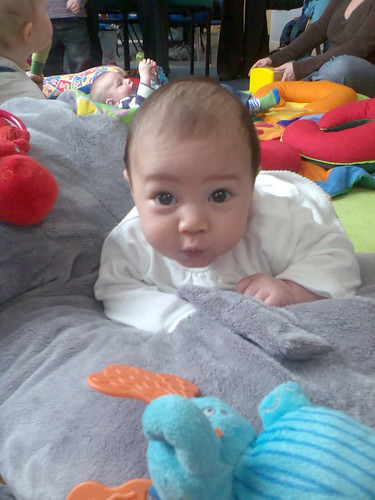
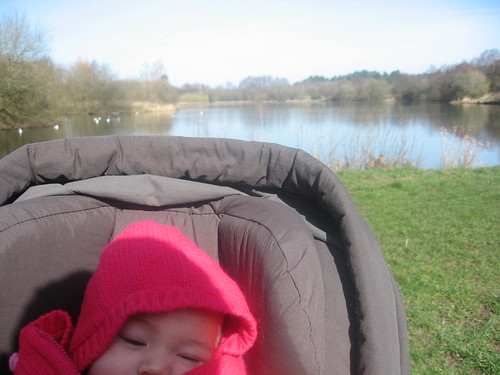
A couple of shots of Louisa Vy at 9 months old. Her face is really looking like her mum's side of the family now despite people also saying she looks like me...
For some reason video recorded on my camera makes a bloody awful noise. Anyway, who cares! 5 months and already gobbling porridge. Apparently she can't wait to try some Pho stock.
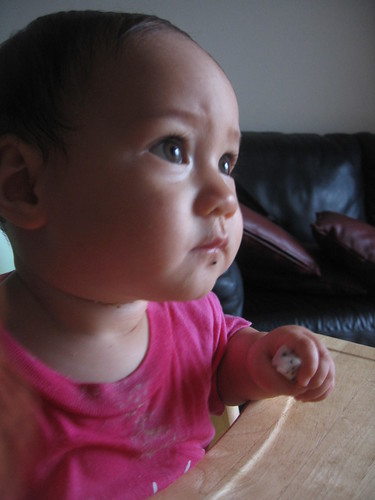
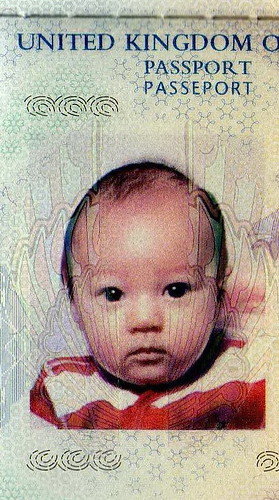
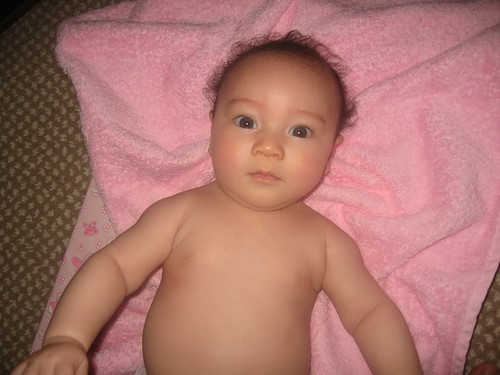
I remember when I was a kid we were included in our parents pass ports. Now even little babies need pass ports. So in five years time when Lousia is a walking talking little girl with long hair I'll be showing this picture of a 10 week old baby to grim faced immigration officials.
Louisa says:
"That's bloody stupid, but they must be making a fortune from all those extra passports."
When informed that he had gotten a girlfriend pregnant, George pondered for a minute, looking shocked, and then screamed 'I did it! My boys can swim!' as he ran down the hall in celebration.
Whilst not quite my reaction, Chi is pregnant (3 months) and before Christmas (last week of November) we'll have a baby added to the family. As the weeks go by, my anticipation builds. Brief flashes of what awaits come vividly on occasion, leaving a feeling of disbelief mixed with pure adrenalin. What an adventure this will be...